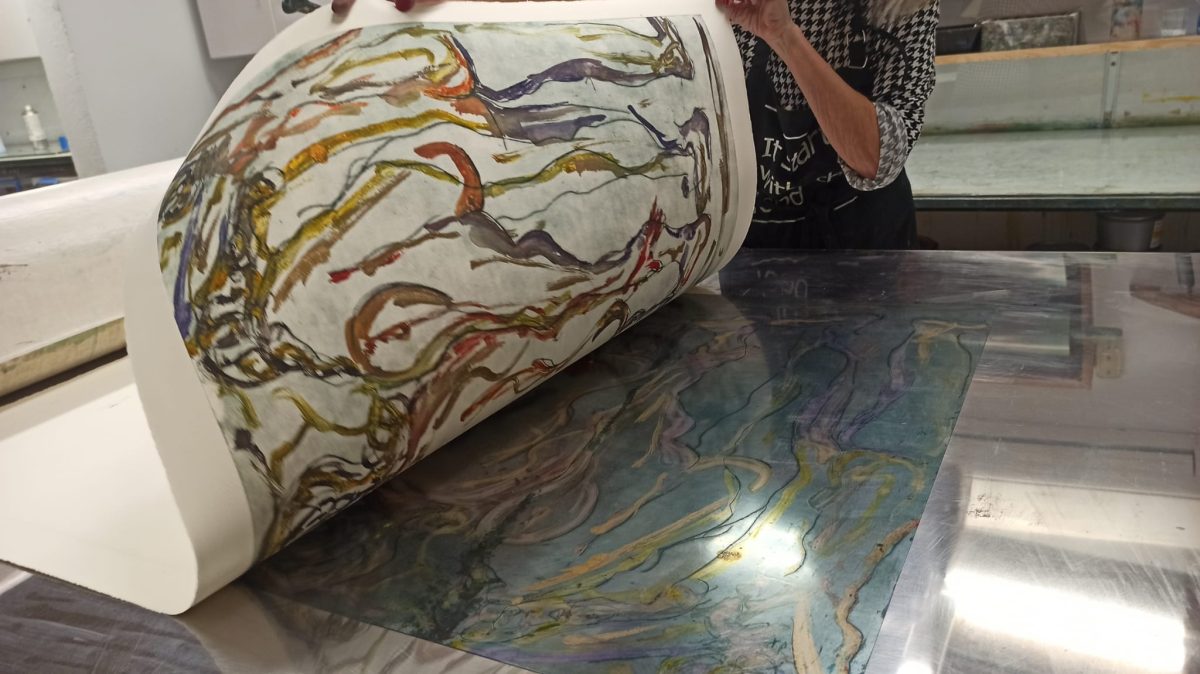
Have you ever noticed that, in a print, the image we draw is not the one we will see? That we have to think of it in reverse, and that until we lift the paper we do not quite know what we will find?
Printmaking is one of the oldest ways of reproducing images. It means working a surface, which we call the matrix or plate, so that it holds ink in some places and not in others, and then transferring it to paper with pressure. The plate can be wood, linoleum, metal or even cardboard. Many copies can come from the same plate, and each one is an original print.
At Traç, we believe printmaking has something that sets it apart from drawing or painting: it asks not only for a hand and an eye, but also for patience, foresight and a willingness to be surprised.

What printmaking techniques are there, and what makes them different?
Printmaking techniques differ above all in where the ink sits. In relief printing, such as woodcut or linocut, everything that should not print is carved away, and the ink rests on the surface that remains. Intaglio works the other way round: the image is cut into a metal plate with a needle, a burin or acid, as in etching. The ink settles in the grooves and the press transfers it to damp paper.
A monotype, on the other hand, gives only one print: you paint directly onto a smooth plate and what is printed cannot be repeated. Additive plates, such as collagraphs, are built by gluing materials and textures onto a support, so the plate grows instead of being carved away.
Each technique has its own way of thinking. Carving wood makes you decide what will be light and what will be shadow; cutting into metal calls for a precise line; building a plate with textures invites you to play with whatever is at hand.

Why does such a slow process, with so many steps, interest us so much?
Because in printmaking you can see the process at every moment. Preparing the plate, inking it, wiping it, placing the paper, running it through the press and lifting the sheet. Each step has its own decisions and small accidents, and it is often in those accidents that the most interesting things appear.
We also like it because printmaking teaches us to think about the image before making it, and at the same time to accept that the result will not always be what we had imagined. The image comes out reversed, the ink does not always behave as we expected and each print is a little different from the last.
There is also a shared side to it. The printmaking workshop is a place where tools are shared, where you look at what the person next to you is doing and where a proof is discussed together before deciding how to go on.

And how do we work on printmaking at Traç?
Our printmaking workshop has a press ready for large-format paper, rollers and the materials to work on woodcut, linocut, intaglio, monotype, additive plates and printing in one or several colors. It brings together people trying it for the first time and people who have been exploring it for years, in small groups and with the guidance of our teachers.
In early 2024, for example, we offered printmaking capsules: one-month courses to discover one technique at a time, from monotype to green printmaking, collagraph, relief printing, etching and soft-ground etching. No previous knowledge was needed to sign up.
Because printmaking is, in the end, a way of leaving a trace: a mark that can be repeated, shared and looked at again. And perhaps that is why, when we lift the paper and see the image for the first time, it still surprises us.
Here are some pictures of our printmaking workshop!